
Table of Contents
- What Third-Party Testing for Herbal Supplements Actually Means
- Why Independent Testing Matters for Botanical Ingredients
- Botanical Identity Testing: Confirming What's Really in the Bottle
- Herbal Supplement Contaminant Testing: Heavy Metals, Pesticides, and More
- How to Read an Herbal Supplement Certificate of Analysis
- Supplement Third-Party Testing Certifications: What They Do and Don't Guarantee
- How to Verify a Brand's Testing Claims Before You Buy
- Conclusion
- Frequently Asked Questions
Last Updated: October 13, 2026
What Third-Party Testing for Herbal Supplements Actually Means
Third party testing for herbal supplements means sending a product or its raw ingredients to an independent laboratory with no financial relationship to the brand, so identity, potency, and contaminants are verified by someone other than the seller.
Most people assume the label tells the whole story. It doesn't. A bottle can say "moringa leaf powder" and contain mostly stem, filler, or a different plant, with nothing on the front hinting at the swap.
Independent Laboratory vs. In-House Testing
An independent laboratory has no ownership or financial stake in the brand whose product it analyzes. In-house testing happens in the company's own facility, or in a lab it owns or contracts directly.
Both have a place: in-house screening catches problems early and is faster and cheaper for routine checks.
The distinction matters most for botanicals, where a supplier can substitute one leaf for another and the difference is invisible without chemical analysis.
Why Independent Testing Matters for Botanical Ingredients
Herbal supplements are harder to verify than most products because plants are chemically messy.
The FDA's dietary supplement guidance places the responsibility for safety and labeling on the manufacturer, but it does not require pre-market approval for most supplements.
Three problems show up again and again in herbal products:
- Adulteration - a cheap herb substituted for an expensive one
- Dilution - a product that contains far less of the labeled herb than claimed
- Contamination - heavy metals, pesticides, or microbes picked up from soil or processing
Independent testing is the only practical way to catch all three before a product reaches your shelf. A supplier's word is not evidence.
Botanical Identity Testing: Confirming What's Really in the Bottle
Botanical identity testing confirms that the plant material in a product is the species named on the label, using chemical or genetic methods rather than visual inspection. It answers the most basic buyer question: is this what it says it is?
Visual inspection fails with dried, powdered, or extracted herbs: once a leaf is ground into powder, you cannot tell moringa from a dozen other green powders by looking.
Marker Compounds and Chemical Profiles
A marker compound is a specific chemical used to identify and quantify a particular herb.
Ginsenosides mark ginseng, curcuminoids mark turmeric, and rosmarinic acid marks several mint-family herbs. Measuring marker compounds checks two things at once: that the right plant is present, and that enough of it is there to match the label claim.
This is where herbal testing gets difficult: a product can pass identity testing and still fail on potency, or pass potency and carry a contaminant. Each test answers one question.
Herbal Supplement Contaminant Testing: Heavy Metals, Pesticides, and More
Herbal supplement contaminant testing screens for substances plants absorb, collect, or acquire during processing. Because herbs are grown in soil, dried in the open, and often extracted with solvents, they pick up whatever is in their environment or manufacturing line.
The standard contaminant panel covers five categories, and each one measures something different:
- Heavy metals, lead, arsenic, cadmium, and mercury, which plants take up from soil, water, and airborne deposition. Testing measures the concentration in the finished material, usually in parts per million (ppm) or parts per billion (ppb).
- Pesticide residues, chemicals applied during cultivation that persist through drying and milling. Labs screen against multi-residue panels that can cover hundreds of compounds at once.
- Microbial contamination, total aerobic bacteria, yeast, mold, and specific pathogens such as Salmonella and E. coli. Results are reported as colony-forming units per gram (CFU/g).
What Limits and Detection Limits Actually Mean
Testing is never pass-or-fail in the abstract. Every result compares against a specification limit, and every method has a detection limit below which the lab cannot reliably see anything.
A specification limit is the maximum amount of a contaminant allowed in the product.
A common pattern in weak certificates of analysis is a contaminant panel with no detection limits listed.
How to Interpret Pass/Fail Results
When you read a contaminant result, work through four questions in order:
- What was the specification limit? If the COA doesn't state one, the pass/fail column is meaningless.
- What was the detection limit? A low detection limit with a "not detected" result is strong evidence. A high detection limit with the same result is weak evidence.
- What units are reported? ppm and ppb differ by a factor of 1,000. A result that looks small in one unit can be large in another.
- Was the sample representative? A result applies to the sample tested, not automatically to the whole lot.
Why Contaminant Testing Is Not One Test
Heavy metals, pesticides, microbes, mycotoxins, and residual solvents require different instruments, sample preparation, and often different laboratories. A brand that says "third party tested" without specifying which panels were run may have tested for identity only, which says nothing about whether the product carries lead or mold.
How to Read an Herbal Supplement Certificate of Analysis
A certificate of analysis (COA) is the document a laboratory issues after testing a sample, listing what was tested, the method, the result, and whether the sample passed.
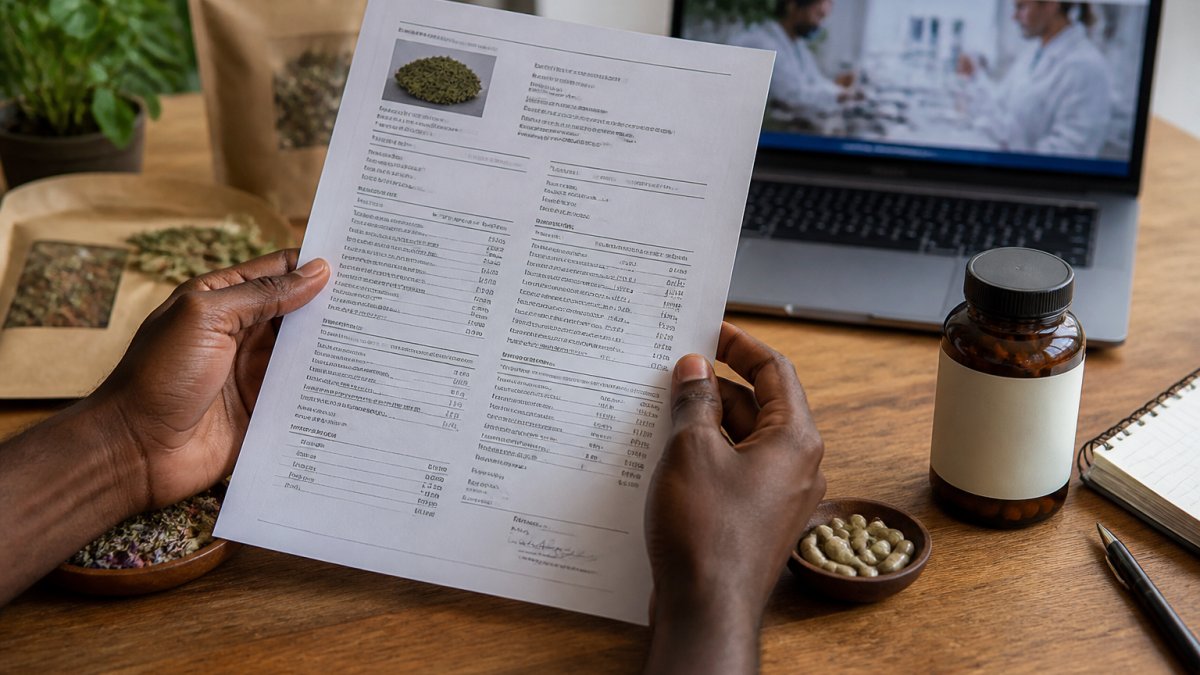
Start with the identifiers. A legitimate COA names the specific product and ties it to a lot number, so you can confirm the report matches your bottle. Without a lot number, it proves nothing about your batch.
What a COA Should Include
A complete certificate of analysis should contain all of the following:
- Product name and lot number matching your bottle
- Name and location of the testing laboratory
- Laboratory accreditation status
If any are missing, the document is incomplete. A COA without a lot number is a marketing asset, not a quality record; one without detection limits tells you a substance wasn't found, but not how hard the lab looked.
Supplement Third-Party Testing Certifications: What They Do and Don't Guarantee
Supplement third-party testing certifications verify that a product or facility met a specific standard at a specific point in time. They are useful signals, not guarantees beyond that scope. Most buyers confuse three different things, regulatory requirements, voluntary certification, and independent laboratory testing, as if they were the same.
Three Different Layers of Oversight
Regulatory requirements are the legal baseline for every manufacturer.
Voluntary certification is a step above the legal floor. A certifier audits a brand's processes against a published standard and may spot-check products.
Independent laboratory testing is separate from certification. A lab analyzes a sample and issues a certificate of analysis; it does not audit the facility, certify the brand, or guarantee future batches.
A product can be certified without every batch being tested, batch-tested without any certification, or meet regulatory requirements without either.
What Certification Confirms and What It Doesn't
| What certification confirms | What it does not confirm |
|---|---|
| A defined standard was met at audit time | Every future batch meets it |
| An outside body reviewed the process | The product treats any condition |
| Identity and purity at testing | Clinical effectiveness |
| A documented quality system | That the label is fully accurate for every lot |
| Facility practices met a published standard | That the raw material supply chain is traceable |
Certifications are a starting point for trust, not the end of the conversation. Use them alongside a readable COA, not instead of one.
The Limits of Certification as Evidence
Certification programs typically audit on a schedule, annually, for example, and may test only a sample or two. A certified brand could pass an audit in January and ship a non-conforming batch in June; the certification stays valid, but it doesn't speak to June.
That's why the strongest quality programs layer all three: cGMP compliance as the legal floor, certification as an outside audit of the process, and lot-level independent testing as evidence that a specific batch matches its label.
Certification is not proof of efficacy, and no certifier claims it is. A product can be pure and accurately labeled and still not do what the marketing implies, a separate question from quality that no certificate of analysis can answer.
How to Verify a Brand's Testing Claims Before You Buy
Verification comes down to asking for documents and reading them carefully.
Here's how we'd walk through it:
- Ask for the COA for the lot you're buying. Not a sample, not a screenshot. The actual document tied to the batch.
- Check the lab name. Look up whether the laboratory exists and whether it holds accreditation.
- Confirm the lot number matches your bottle. This is the step most people skip, and it's the one that matters.
- Read the detection limits. A "not detected" result with a loose detection limit is weaker than it sounds.
- Look for a contaminant panel, not just identity. Identity alone doesn't address heavy metals or pesticides.
- Ask how often testing happens. Batch testing beats annual spot checks every time.
Supply-chain traceability ties into all of this. If a brand can't say where its raw material came from, it can't tell you how representative its sample was; one tested batch from one supplier says little about the next shipment.
That's the standard we hold ourselves to at Rastaman Brew: wildcrafted Jamaican herbs, sustainably sourced, with the documentation to back the claim.
Conclusion
The real challenge with herbal supplements isn't finding a brand that says "third party tested." It's finding one that can show the paperwork, explain the methods, and answer a follow-up question without flinching.
At Rastaman Brew, we source wildcrafted Jamaican herbs and Caribbean superfoods, from organic loose leaf teas to sea moss and moringa powders, and we're glad to talk through the testing behind them.
Get started with Rastaman Brew and build a wellness routine on herbs you can actually trace from root to cup.
Frequently Asked Questions
What does third-party testing check for in herbal supplements?
Third-party testing verifies ingredient identity, potency, and purity. It checks that botanical ingredients match their label claims using marker compounds and chemical profiles. Labs also screen for heavy metals like lead and arsenic, pesticide residues, microbial contamination including pathogens, mycotoxins, and residual solvents. Some tests detect adulteration or substitution, where a cheap filler replaces the herb you paid for. The scope depends on the lab and the product, so always review what a certificate of analysis actually covers.
Does the FDA approve or test herbal supplements before they are sold?
No. The FDA does not approve or test dietary supplements before they reach the market. Under the Dietary Supplement Health and Education Act (DSHEA), manufacturers are responsible for ensuring their products are safe and accurately labeled. The FDA can take action after a product is sold if it finds violations, but there is no pre-market approval step. This is exactly why independent third-party testing matters: it fills a gap the regulatory system leaves open.
What should an herbal supplement certificate of analysis include?
A complete certificate of analysis should list the product name, lot number, and testing date. It should identify the independent laboratory and its accreditation. Look for test results covering ingredient identity, potency, and contaminant screening. Each result needs a specification, a pass/fail threshold, and the analytical method used. The COA should also state detection limits for contaminants. If a document only says 'passed' without numbers or methods, it is not a meaningful certificate of analysis.
Can third-party testing detect adulteration in herbal supplements?
Yes, when the right methods are used. Botanical authentication techniques like DNA barcoding, high-performance thin-layer chromatography (HPTLC), and high-performance liquid chromatography (HPLC) can identify whether the expected plant species is present. These methods also flag substitution, where a cheaper herb or filler replaces the labeled ingredient. Adulteration detection depends on testing the right marker compounds and comparing results against a verified reference standard. A generic 'pass' result without identity testing will not catch adulteration.
What is the difference between third-party testing and third-party certification?
Third-party testing means an independent lab analyzes a specific batch and reports results. Third-party certification means a program reviews a company's testing, manufacturing, and quality systems over time, then allows the brand to display a seal. Testing is a snapshot of one lot. Certification is an ongoing commitment with periodic audits. Both have value, but certification alone does not replace batch-level testing results. Ask for the certificate of analysis for the exact lot number on your bottle.
How can I tell if an herbal supplement is third-party tested?
Look for a lot number on the package, then check whether the brand publishes a matching certificate of analysis on its website. Contact the brand directly and ask which independent laboratory performed the testing and what the lab's accreditation is. Certification seals from recognized programs are a good sign, but they are not proof that every batch was tested. A brand that shares batch-specific results openly is the strongest signal of genuine third-party testing.


