
Last Updated: October 24, 2026
Quick Summary
Organic loose leaf ginger tea is worth it if you drink ginger tea regularly and care about flavor and ingredient transparency, since whole root pieces hold their aroma longer and let you adjust strength by the spoonful. It is not worth it if you want convenience above all else, because it takes an extra minute to brew and needs a strainer.
- Loose leaf ginger usually costs $0.16 to $0.36 per cup versus $0.20 to $0.40 for tea bags.
- Brew with 8 ounces of water near 200°F, 1 to 1.5 teaspoons of dried ginger, and steep 5 to 7 minutes.
- Ginger has a mild blood-thinning effect, so ask your doctor before daily cups if you take blood thinners.
- USDA Organic certification is a farming standard, not a guarantee of freshness, strength, or safety.
- Most dried ginger holds good flavor for about 12 months, so store it airtight away from light and heat.
Table of Contents
- What You Actually Get From Organic Loose Leaf Ginger Tea
- Loose Leaf Ginger Tea vs Tea Bags: Flavor, Freshness, and Control
- How to Brew Loose Leaf Ginger Tea for Consistent Cups
- Loose Leaf Ginger Tea Price Per Cup: The Real Cost Breakdown
- Ginger Tea Side Effects and Who Should Be Cautious
- How to Verify Organic Certification and Loose Leaf Quality
- Choosing Your Organic Loose Leaf Ginger Tea
- Frequently Asked Questions
What You Actually Get From Organic Loose Leaf Ginger Tea
Organic loose leaf ginger tea is whole, dried ginger root that has been certified organic and sold in leaf or piece form rather than sealed into bags.
At Rastaman Brew, we sell loose herbal teas, so we have a stake in this answer.
What you actually get in the bag:
- Whole ginger root pieces, not dust and fannings left over from processing
- Certified organic sourcing, which limits synthetic pesticide use at the farm level
- No added flavorings, sweeteners, or anti-caking agents in plain ginger tea
The trade-off is real too. Loose leaf takes an extra minute to brew, needs a strainer or infuser, and costs more upfront per package.
Loose Leaf Ginger Tea vs Tea Bags: Flavor, Freshness, and Control
Loose leaf ginger tea wins on flavor and control. Tea bags win on speed and cleanup. That is the whole comparison in two sentences.
Here is how the two formats actually differ in practice:
| Factor | Loose Leaf | Tea Bags |
|---|---|---|
| Flavor strength | Adjustable by the spoonful | Fixed per bag |
| Freshness | Whole pieces hold aroma longer | Ground tea stales faster |
| Brewing time | 5-10 minutes, your call | Usually 3-5 minutes |
| Cleanup | Needs a strainer or infuser | Drop and toss |
| Ingredient visibility | You see the actual root | Often obscured |
| Cost per cup | Usually lower at volume | Usually higher |
The freshness point matters more than most guides admit.
A common mistake is buying a large bag of loose leaf, decanting it into a clear jar on the windowsill, and wondering why it goes flat in a month.
Flavor also swings with format. Tea bags give you a predictable, mild cup.
How to Brew Loose Leaf Ginger Tea for Consistent Cups
Consistent cups come down to three numbers: water temperature, leaf quantity, and steeping time. Get those right and every cup tastes like the last one.
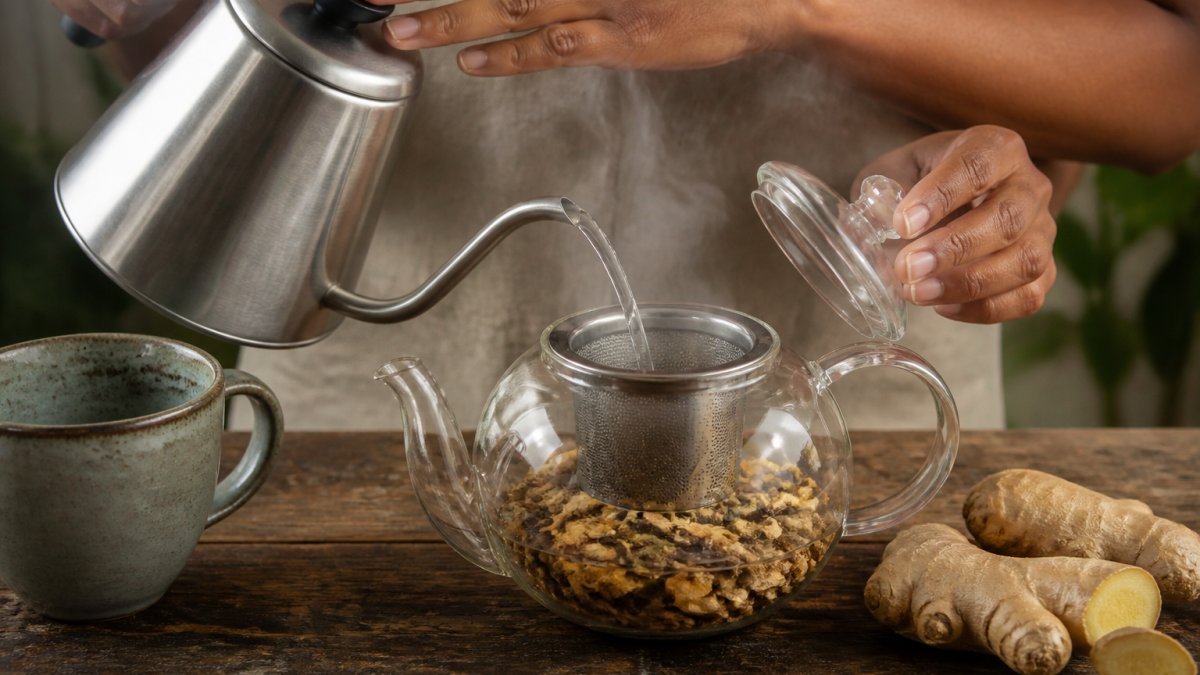
Use this as your baseline:
- Water: 8 ounces, heated to just below boiling, around 200°F
- Leaf: 1 to 1.5 teaspoons of dried ginger pieces
- Time: 5 to 7 minutes for a balanced cup, 10 for a strong one
- Strain: pour through a fine mesh strainer or lift out your infuser
If you want the full walkthrough, our guide on how to brew loose leaf herbal tea covers water ratios and timing for every style of herbal leaf. And if you are still deciding what to brew in, our breakdown of the best tea infuser for loose leaf tea will save you from buying the wrong basket.
Two adjustments worth knowing. First, dried ginger is more concentrated than fresh, so start with less than you think. Second, if you like iced tea, brew a double-strength batch, strain it, and chill it before adding ice so it does not turn watery.
Watch out: boiling ginger pieces hard for 15 minutes or more pulls out bitter notes along with the heat. If your cup tastes sharp and drying rather than warm and spicy, you over-steeped.
Loose Leaf Ginger Tea Price Per Cup: The Real Cost Breakdown
Price per cup is where loose leaf quietly wins, and where most comparisons stop short. The problem with most "is it worth it" answers is that they never do the arithmetic.
The formula is simple:
Cost per cup = package price ÷ number of cups per package
For loose leaf, cups per package depends on your scoop size. A standard teaspoon of dried ginger pieces weighs roughly 1.5 to 2 grams.
Here is how the three main options compare on a per-cup basis, using typical U.S. retail price ranges rather than a single quoted price:
| Option | Typical package price | Yield | Approx. cost per cup |
|---|---|---|---|
| Organic loose leaf ginger (4 oz) | $12-$20 | 56-75 cups at 1 tsp | $0.16-$0.36 |
| Ginger tea bags (20-count box) | $4-$8 | 20 cups | $0.20-$0.40 |
| Fresh ginger root | $2-$4 per lb | 12-20 cups per lb | $0.10-$0.33 |
A few things stand out.
Run the numbers on your own three options before you commit:
- Loose leaf organic ginger: divide package price by the teaspoons in the bag, then by your scoop size
- Ginger tea bags: divide box price by bag count
- Fresh ginger root: divide root price by the slices you get per knob
One caveat: cheap loose leaf is often cheap for a reason.
Ginger Tea Side Effects and Who Should Be Cautious
Ginger tea is generally well tolerated, but it is not risk-free for everyone. Most people can drink a cup or two daily without issue.
The common, mild effects include heartburn, a warm or burning sensation in the stomach, and loose stools in larger amounts.
Talk to your healthcare provider before making ginger tea a daily habit if you:
- Take blood thinners or antiplatelet medication
- Have gallstones or a history of gallbladder issues
- Are pregnant or breastfeeding
For a broader look at how herbal teas interact with common conditions and medications, our guide to herbal tea safety walks through the cautions in more detail.
How to Verify Organic Certification and Loose Leaf Quality
Verification comes down to paperwork and your own senses. A real organic claim is backed by a certifier you can look up. A vague "natural" or "pure" label is not the same thing.
What organic certification actually verifies
In the United States, organic tea sold as organic must be certified under the USDA National Organic Program. That certification is a production standard, not a health claim. It verifies that the ginger was grown and handled according to rules that, among other things:
- Prohibit synthetic pesticides, synthetic fertilizers, and sewage sludge on the farm
- Require a buffer zone between organic and conventional fields
- Prohibit genetic engineering and irradiation
What it does not verify: that the tea is stronger, fresher, safer in absolute terms, or better for you than conventional ginger. It also does not guarantee the ginger was grown in any particular country or harvested recently. Organic is a farming and handling standard, nothing more, nothing less.
How to read the label
The package should carry the USDA Organic seal along with the name of the certifying agent. You can check that certifier against the USDA Organic Integrity Database to confirm the operation is actually certified. If a seller cannot tell you who certified them, that is your answer.
Watch for these label traps:
- "Made with organic ingredients", only 70% or more of the ingredients are organic; the seal cannot be used
- "100% organic", every ingredient is organic; the seal can be used
- "Natural" or "pure", no legal definition for tea; means nothing about farming
Judge quality with your senses
Certification tells you how the ginger was grown. It does not tell you whether the bag in your hand is fresh. Use your senses for that:
- Smell: fresh ginger pieces should smell sharp and warm, not dusty or flat
- Look: whole, uniform pieces beat a bag of powder and stems
- Touch: pieces should be dry and firm, not soft or clumping
- Taste: a small test cup should taste clean and spicy with no mustiness
Storage protects quality
Keep your tea in an airtight container away from light and heat, and use it within a reasonable window, most dried ginger holds good flavor for about 12 months, then fades. Buy in quantities you will actually drink.
Choosing Your Organic Loose Leaf Ginger Tea
Choosing well means matching the tea to how you actually drink it. Buy for your habit, not for the label.
Work through these criteria in order:
- Certification: look for the USDA Organic seal and a named certifier
- Ingredient list: plain ginger should list ginger, nothing else
- Format: whole pieces for flavor, powder for speed
- Package size: small if you are new to it, larger once you know you like it
If you are ready to browse, you can explore our full tea collection to see the loose leaf options we carry. If organic sourcing is your priority, our organic herbal tea selection groups those blends together so you can compare them in one place.
Our own approach at Rastaman Brew is wildcrafted Jamaican herbs, sustainably sourced, with organic loose leaf and powdered options. That is the standard we hold ourselves to, and it is the standard worth asking of anyone you buy from.
Frequently Asked Questions
Is organic loose leaf ginger tea better than tea bags?
Loose leaf gives you larger, fresher pieces and lets you control strength, so flavor is usually fuller and spicier. Tea bags are convenient and consistent but often contain finer dust and fewer whole pieces. Organic loose leaf also avoids synthetic pesticides tied to conventional farming. The trade-off is brewing time and the need for a strainer. If you drink ginger tea daily and care about flavor and ingredient transparency, organic loose leaf is the better long-term choice.
How much loose leaf ginger tea should you use per cup, and how long should you steep it?
Use about 1 to 2 teaspoons of dried loose leaf ginger per 8-ounce cup, or 1 tablespoon of fresh grated root. Steep in water just off the boil for 5 to 10 minutes; longer steeping brings more heat and spice. For iced tea, brew double strength and pour over ice. A tea strainer or infuser keeps the leaves out of your cup. Adjust amounts to taste, since ginger potency varies by harvest and cut size.
Does ginger tea have any side effects?
Ginger is generally well tolerated, but large amounts can cause heartburn, stomach upset, or a mild burning sensation. It may interact with blood-thinning medications, so talk to your doctor if you take warfarin or similar drugs. People with gallstones should be cautious. Keep daily intake moderate, roughly 2 to 4 cups of tea, and watch for discomfort. If you are pregnant or managing a health condition, confirm with your clinician before making it a daily habit.
How can you tell if organic loose leaf ginger tea is good quality?
Look for large, uniform pieces rather than dusty fragments, a strong ginger aroma when you open the package, and a clear organic certification seal from a USDA-accredited certifier. Check the ingredient list for additives or flavorings. Freshness matters: buy from suppliers who pack in small batches and store the tea in an airtight container away from light and heat. Customer reviews mentioning flavor and aroma can also signal quality, but certification and sourcing details are the most reliable proof.
The real question is not whether loose leaf costs more on the shelf. It is whether you will drink it often enough for the flavor and control to pay you back. If you want a cup you can tune to your own taste, brewed from root you can actually see, start with a small package and test it against your usual bag.
Get started with Rastaman Brew and explore organic loose leaf teas sourced with the same care we put into every wildcrafted herb we carry.


