
Table of Contents
- Why Sea Moss Heavy Metal Testing Matters
- Which Heavy Metals Should Sea Moss Be Tested For?
- How Sea Moss Lab Testing Works
- Third-Party Testing for Sea Moss: Why Independence Counts
- Reading a Sea Moss Certificate of Analysis
- Sourcing, Growing Environment, and Contaminant Exposure
- What Sea Moss Heavy Metal Testing Cannot Tell You
- Frequently Asked Questions
Last Updated: October 17, 2026
Why Sea Moss Heavy Metal Testing Matters
Sea moss heavy metal testing is the laboratory analysis of seaweed to measure arsenic, lead, cadmium and mercury before the product reaches a customer. Sea moss absorbs minerals from seawater, and that same mechanism can concentrate contaminants. This guide from Rastaman Brew explains how to judge a lab report rather than a marketing claim.

Seaweed does not filter selectively, so the question is never whether sea moss contains minerals, it is what else came along with them. A jar of gel with a gold label tells you nothing about the batch inside it.
Most buyers ask "is this brand tested?" when they should ask "what was tested, at what limit, and can I see the report for my batch?" Below, we walk through the metals that matter, how testing works, and how to read a certificate of analysis without a chemistry background.
Which Heavy Metals Should Sea Moss Be Tested For?
Four metals form the core panel for any seaweed product: arsenic, lead, cadmium and mercury. A complete report also covers iodine content and, ideally, microbiological contaminants.
Arsenic deserves the most attention in seaweed specifically. Organic arsenic compounds are far less harmful than inorganic arsenic, the form regulators focus on for toxicity. A useful certificate of analysis separates inorganic arsenic from total arsenic, because a total-arsenic number alone can look alarming while telling you very little.
Lead and cadmium accumulate in marine environments and are the metals most commonly flagged in seaweed testing programs. Mercury appears less often in seaweed than in fish but belongs on the panel regardless.
Iodine is not a contaminant, but it belongs in this conversation. Sea moss is a genuinely rich iodine source, which is both a benefit and a risk depending on how much you consume. A report that lists iodine content helps you understand your serving.

| Metal or Marker | Why It Matters | What a Good Report Shows |
|---|---|---|
| Inorganic arsenic | Most toxic form in seaweed | Speciated result, not just total |
| Lead | Accumulates in marine environments | Result with reporting limit |
| Cadmium | Common in seaweed testing programs | Result with reporting limit |
| Mercury | Less common but part of the panel | Result with reporting limit |
| Iodine | Nutrient and overconsumption risk | Content per gram or serving |
How Sea Moss Lab Testing Works
Sea moss lab testing follows a defined chain: sampling, digestion, instrumental analysis, and reporting. Each step has failure points, and the report should show where your batch sat in that chain.
Sampling comes first, and it is where most credibility is won or lost. A lab can only test the material it receives, so a single scoop from a large production run describes that scoop, not your jar. Batch-level sampling, where each production lot is tested separately, is the standard worth demanding.
Digestion follows: the lab breaks the sample down in acid so the metals move into solution. Then instruments take over, most commonly inductively coupled plasma mass spectrometry, or ICP-MS, which detects metals at very low concentrations, exactly what you want for trace contamination.
Reporting is the last step, and the most misunderstood. "Not detected" is not a guarantee of zero; it means the metal was below the method's detection limit. A report that states its reporting limits is more honest than one that simply says "pass."
Third-Party Testing for Sea Moss: Why Independence Counts
Third-party testing for sea moss means a laboratory with no financial stake in the result performs the analysis. Independence is the entire point. A seller's in-house check can produce accurate numbers, but you have no way to verify that, and neither does a regulator.
The practical difference shows up in what gets published. Independent labs issue a certificate of analysis tied to a sample ID, a receipt date and a method, which can be checked against the lab's own records. In-house testing rarely produces anything a customer can independently confirm.
What most guides miss is that third-party testing is not a single event but a schedule. A supplier testing once at launch and never again is telling you about a batch that no longer exists. Ask how often testing happens and whether each lot gets its own report.
We would also flag a subtler issue: a certificate from a lab that no one can locate. Accredited laboratories maintain public listings. If the lab name on the report does not appear in an accreditation directory, treat the document as unverified until proven otherwise.
Reading a Sea Moss Certificate of Analysis
A sea moss certificate of analysis records what was tested, the method used, the result, the reporting limit and the pass or fail determination for a specific batch. Reading one takes about five minutes once you know which fields matter.
Start with identification. The report should name the product, the batch or lot number, and the sample receipt date.
Then move to the results table. For each metal, you want four things: the result, the unit, the reporting limit and the limit it was judged against. A number without a limit is just a number.
The reporting limit, sometimes called the limit of detection or limit of quantitation, tells you the lowest concentration the lab could reliably measure for that metal in that sample. "Not detected" means the metal was below that limit, not that it was absent.
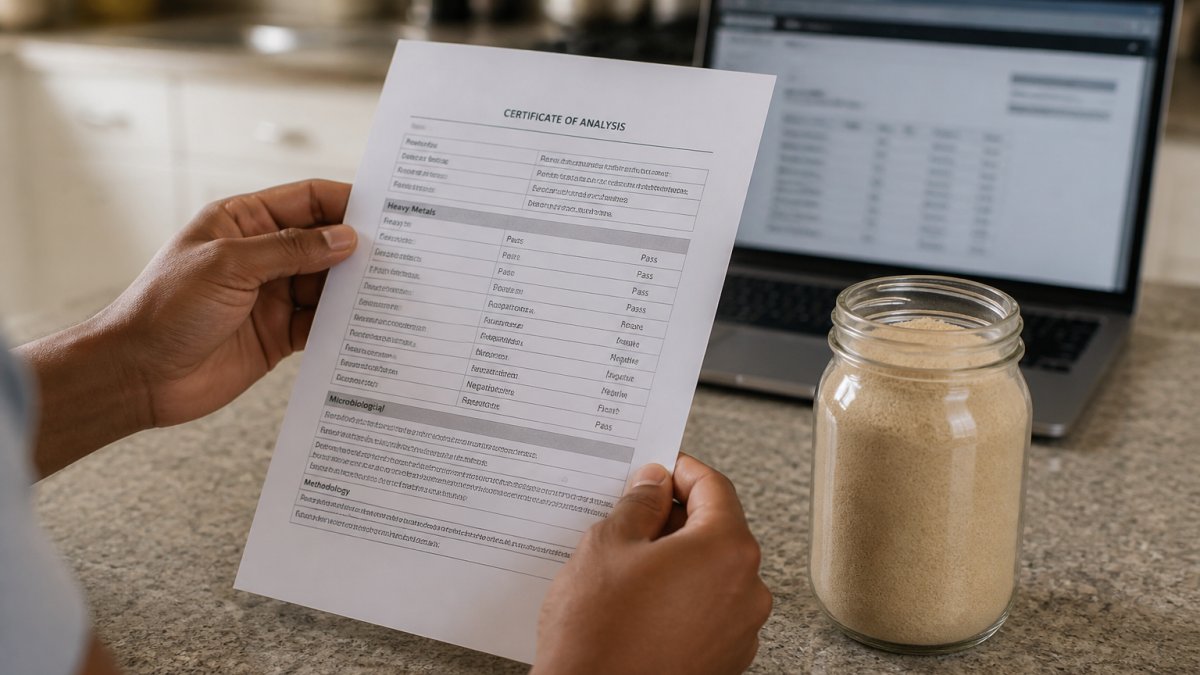
Here is the checklist we would use on any report handed to us:
Jamaican Sea Moss Powder 8oz – Wildcrafted Irish Sea Moss for Smoothies, Teas →
- Product name and lot number match the package you received
- Laboratory name is identifiable and independently verifiable
- Sample receipt date is recent relative to the batch
- Each metal has a result, a unit and a reporting limit
- Units are consistent across rows, or you have converted them
- Inorganic arsenic is reported separately from total arsenic
- The pass/fail limit is stated, not implied
- The document is a full report, not a cropped screenshot
Sourcing, Growing Environment, and Contaminant Exposure
Growing environment drives contaminant exposure more than any processing step. Sea moss takes up what is in the water around it, so harvest location is the first variable in the quality chain.
Coastal waters near industrial discharge, heavy shipping traffic or historic mining runoff carry higher metal loads; open, clean coastal water carries less. A supplier that can describe where its sea moss is harvested, and how, is giving you something checkable.
Wild-harvested versus pool-grown matters here, and not in the direction most people assume. Pool-grown sea moss gives a supplier more control over water quality, which can reduce variability. Wild-harvested sea moss carries the character of its coastline, but the supplier must test more diligently because the inputs are less controlled.
Raw and sun-dried products add a step worth understanding. Drying concentrates everything in the seaweed, minerals and metals alike, so a dried product's metal content per gram reads higher than a wet sample.
At Rastaman Brew, our wildcrafted Jamaican sea moss is harvested by fishermen diving off the Jamaican coast and sun-dried before it reaches us. We point customers toward batch documentation because the sourcing story and the lab report should describe the same product.
What Sea Moss Heavy Metal Testing Cannot Tell You
Testing has real limits, and a guide that skips them is selling confidence rather than accuracy. A certificate of analysis covers the sample, the panel and the moment in time it was tested, nothing more.
Exposure depends on three things: the concentration in the product, the serving size, and how often you eat it. A result of 0.1 mg/kg sounds small, but intake is that concentration multiplied by the grams you consume.
This is why serving size belongs next to the test result. A report that lists metals per kilogram tells you about the powder or gel, not about the spoon you use.
Cumulative exposure is the other piece. Sea moss is rarely the only source of arsenic, lead or cadmium in a diet, rice, leafy greens, some spices and certain seafood also contribute.
Testing also cannot tell you about a batch that was never sampled, or about contaminants outside the panel, pesticides, microplastics or microbial contamination, unless those were specifically requested.
What testing can do is replace guesswork with documentation, a meaningful upgrade over a label claim. Just do not mistake a clean report for a guarantee.
If you want a starting point, our Jamaican Sea Moss Powder 8oz is ground from pure wildcrafted sea moss with no fillers or additives, and our Wildcrafted Jamaican Raw Sea Moss 4oz is sun-dried and sourced directly from Jamaica.
Frequently Asked Questions
Can sea moss contain heavy metals?
Yes. Sea moss grows in the ocean and absorbs minerals from the water, and that same process can draw in heavy metals like arsenic, lead, cadmium, and mercury. Levels depend on where it was harvested and how it was processed. That is why sea moss heavy metal testing matters: a batch-tested product with a current certificate of analysis gives you a documented starting point, while an untested product leaves you guessing about what is in your daily serving.
How can I tell whether a sea moss product has been tested?
Ask for the certificate of analysis, or COA, for the specific batch you are buying. A real report names the laboratory, lists the batch or lot number, shows the test date, and reports results for each metal with units and detection limits. If a seller only says 'lab tested' in marketing copy but cannot produce a batch-specific document, treat the claim as unverified and look for a product that provides one.
Does rinsing or soaking sea moss remove heavy metals?
Rinsing removes surface debris, sand, and some salt, but it does not reliably remove heavy metals that have been absorbed into the plant tissue. Soaking can reduce some surface contamination, yet the metals bound inside the seaweed remain. The meaningful control is testing at the source and at the finished batch, not preparation at home. If a product's lab results show elevated levels, rinsing will not make it safe to consume.
How often should sea moss products be tested?
Each harvest batch should be tested, because contaminant levels change with growing conditions, season, and location. A single test from two years ago says little about the jar you are holding today. Look for a certificate of analysis dated within the last year that matches the batch code on your package, and ask sellers how often they run sea moss lab testing across their supply chain.
What should a sea moss certificate of analysis include?
A complete COA should show the product and batch identifier, the testing laboratory's name and accreditation, the sample receipt and report dates, the test methods used, and results for each heavy metal with units such as mg/kg or ppm. It should also state the reporting limit for each test. A document missing the batch number or the lab's identity is not enough to verify that the results apply to the product you bought.
Can seaweed contain arsenic, lead, cadmium, or mercury?
All four have been documented in seaweed, and arsenic is the one most often discussed because seaweed can take up both organic and inorganic forms. Inorganic arsenic is the form of concern for long-term consumption. This is why sea moss heavy metal testing should report each metal separately and, where possible, distinguish inorganic arsenic from total arsenic so you can interpret the result against applicable limits.
Sea moss heavy metal testing is not a marketing badge, it is a paper trail, and the buyer who knows how to follow it gets a better product than the one who trusts a label. At Rastaman Brew, we source wildcrafted Jamaican sea moss and stand behind the traceability of what we sell, from the coastline to the jar. If you want a supplier who expects the testing question, browse our wildcrafted sea moss collection and start with a batch you can ask about.


