
Last Updated: October 22, 2026
Quick Summary
The best sea moss supplement for beginners is a single-ingredient product you can verify before committing to a daily habit. Start with one small serving a day for the first week, then hold that dose rather than escalating. Choose a product that names its species, states its serving size, and provides a certificate of analysis tied to a lot number.
- Capsules are pre-measured and travel-friendly, but you cannot see the product inside.
- Our Jamaican Sea Moss Powder 8oz is a single-ingredient wildcrafted powder priced at $19.95.
- Consume soaked homemade gel within 3 to 4 weeks refrigerated and label the jar with the date.
- Adults should consult a clinician first if they have a thyroid condition or are pregnant or nursing.
- An 8 oz pouch at $19.95 yielding roughly 75 one-teaspoon servings works out to about $0.27 per serving.
Table of Contents
- Why Beginners Need a Different Approach to Sea Moss
- Capsules, Gels, and Powders: Which Sea Moss Format Fits Your Routine
- Sea Moss Capsules: Convenience With a Label-Reading Catch
- Sea Moss Gel: What to Expect and How to Store It
- How to Take Sea Moss: A Simple Beginner Dosing Routine
- Sea Moss Supplement Safety: Iodine, Heavy Metals, and Interactions
-
How to Choose a Quality Sea Moss Product and Read the Label
- Step 1: Confirm the species and the part of the plant
- Step 2: Read the supplement facts panel like a beginner
- Step 3: Judge ingredient simplicity
- Step 4: Verify testing instead of trusting the word "tested"
- Step 5: Calculate cost per serving, not cost per pouch
- Step 6: Check sourcing language for specifics
- The beginner decision order, summarized
- Conclusion
- Frequently Asked Questions
Why Beginners Need a Different Approach to Sea Moss
Sea moss is a sea vegetable, and the best sea moss supplement for beginners is one you can verify before committing to a daily habit. At Rastaman Brew, we sell wildcrafted Jamaican sea moss in raw and powdered form, and the questions we hear most are about proof: is this real, is it tested, and how much do I take?

That caution is warranted. A review of the research on sea moss found that lab and animal studies suggest possible prebiotic, antioxidant, and immune-related effects, but no well-designed human trials confirm the benefits commonly promoted. National Geographic has also reported that sea moss can contain dangerous levels of heavy metals and iodine.
Below, we break down formats, dosing, safety, and label reading so your first purchase is an informed one.
Capsules, Gels, and Powders: Which Sea Moss Format Fits Your Routine
Capsules win on convenience, gels on versatility, powders on cost per serving and shelf life. The right format depends on how you actually eat, not on which has the loudest marketing.
- Capsules: pre-measured, tasteless, travel-friendly. The tradeoff is that you cannot see or smell the product inside, so the label and testing matter more than ever.
- Gel: made by soaking and blending raw sea moss. Spoonable into smoothies and porridges, but it needs refrigeration and a realistic use-by date.
- Powder: milled dried sea moss. Stirs into drinks, thickens soups, and keeps in the cupboard. Our Jamaican Sea Moss Powder 8oz is a single-ingredient wildcrafted powder with no fillers or additives, priced at $19.95.
| Format | Prep Time | Storage | Best For |
|---|---|---|---|
| Capsules | None | Cool, dry | Travel and tight schedules |
| Gel | 20+ min soak and blend | Refrigerated, use within weeks | Smoothie and porridge routines |
| Powder | Seconds to stir | Sealed pouch, cool and dry | Budget-minded daily use |
Sea Moss Capsules: Convenience With a Label-Reading Catch
Capsules are the easiest entry point and the easiest place to hide a weak product. Because you never see the powder, you are trusting the supplement facts panel completely.

Look for a stated serving size in grams, a clear species name such as Chondrus crispus, and a short ingredient list. Blends that stack bladderwrack, burdock root, black seed oil, ashwagandha, and turmeric sound impressive but make it impossible to know your sea moss dose.
Sea Moss Gel: What to Expect and How to Store It
Sea moss gel is hydrated, blended sea moss with a texture between applesauce and loose pudding. It is mild and slightly oceanic, so it disappears into a flavored smoothie.
You can buy gel ready-made or make it yourself. Our raw Wildcrafted Jamaican Raw Sea Moss 4oz is sun-dried and sold whole at $26.95, and the listing explains how to soak, blend, and store it.
How to Take Sea Moss: A Simple Beginner Dosing Routine
Start with one small serving a day for the first week, then hold that dose rather than escalating. A common approach is one teaspoon of powder in a smoothie, juice, or tea, or roughly two tablespoons of gel.
Build the habit around something you already do: morning coffee, a post-yoga shake, or an evening tea.
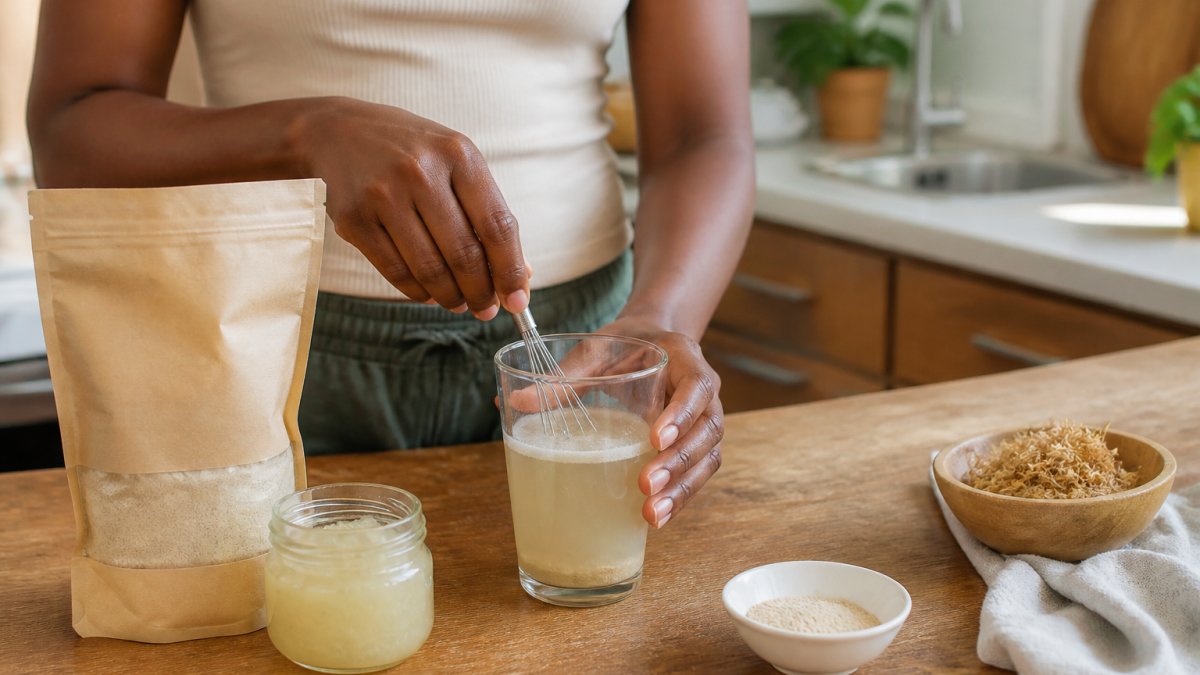
A practical first month looks like this:
- Week 1: one teaspoon of powder or two tablespoons of gel daily.
- Week 2: keep the same dose and note how you feel.
- Week 3: adjust only if you have a reason to.
- Week 4: decide whether the routine is worth the cost per serving.
Sea Moss Supplement Safety: Iodine, Heavy Metals, and Interactions
Most sea moss articles mention iodine and heavy metals in a single sentence and move on. Beginners need more, because sea moss is a concentrated seaweed product and safety questions determine whether you should take it at all.
Why iodine is the central safety issue
Seaweed concentrates iodine from seawater, and the amount varies widely by species, harvest location, and processing. The National Institutes of Health Office of Dietary Supplements publishes iodine fact sheets that set the recommended dietary allowance for adults at 150 micrograms per day and a tolerable upper intake level of 1,100 micrograms per day for adults.
Too much iodine can disrupt thyroid function in susceptible people, so the first safety question is not "is it natural" but "how much iodine is in a serving, and has anyone measured it (pubmed.ncbi.nlm.nih.gov)?"
Who should talk to a healthcare professional first
Be cautious and consult a clinician before starting sea moss if any of the following apply:
- You have a thyroid condition, including hypothyroidism, hyperthyroidism, Hashimoto's thyroiditis, or Graves' disease.
- You take thyroid medication such as levothyroxine, or any medication that affects thyroid function.
- You are pregnant or nursing. Iodine needs change during pregnancy, and the fetus and infant are sensitive to both deficiency and excess.
This is not a complete list or medical advice. The point is that sea moss is not a neutral food for everyone, and a clinician who knows your history should weigh it.
Heavy metals and why sourcing is a safety issue
Seaweed can take up arsenic, cadmium, lead, and mercury from the water it grows in, depending on harvest region and species. National Geographic has reported concerning heavy metal and iodine levels in some sea moss products.
Jamaican Sea Moss Powder 8oz – Wildcrafted Irish Sea Moss for Smoothies, Teas →
The only way to know is testing. Ask for a certificate of analysis covering heavy metals and tied to a lot number. A seller who tests every batch produces it quickly; one who does not will change the subject.
Possible interactions and additive concerns
Beyond iodine, two categories matter:
- Thyroid and iodine-related medications. Because sea moss can deliver a meaningful iodine dose, it can interact with how thyroid medication is absorbed or how the thyroid gland responds. Timing and dose matter, and a pharmacist or physician can advise.
- Blood thinners and other medications. Seaweed contains varying amounts of vitamin K and other compounds, and some people on anticoagulants are advised to keep vitamin K intake consistent. This is a conversation to have with your prescriber, not a conclusion to draw from a label.
On additives: some gel and capsule products include thickeners, sweeteners, or preservatives, so read the full ingredient list, not just the front of the package.
A realistic way to start, safety-first
- Check for contraindications first. If you have a thyroid condition, are pregnant or nursing, or take thyroid medication, talk to a clinician before your first serving.
- Choose a product with disclosed iodine testing if you can find one. If iodine is not disclosed, start with a small serving and do not escalate quickly.
- Start low and hold. One small serving per day for the first week is a common conservative approach. Do not stack multiple sea moss products.
- Watch for symptoms. Changes in energy, heart rate, temperature sensitivity, or sleep are worth noting and worth mentioning to a clinician if they persist.
- Keep the COA with the product. If a reaction occurs, the lot number and testing document help you and your clinician figure out what you took.
Sea moss is a dietary supplement, not a medication. If you have a medical condition or take prescription medication, consult a healthcare professional before adding it to your routine. This article is educational and is not medical advice.
How to Choose a Quality Sea Moss Product and Read the Label
Most sea moss buying guides hand you a checklist and stop there. A beginner needs a decision order: which criteria to check first, which are dealbreakers, and how to verify claims. Use this framework in sequence, because a product that fails step one should not get your money no matter how good the rest of the label looks.
Step 1: Confirm the species and the part of the plant
Sea moss supplements are usually made from Chondrus crispus, the red alga commonly called Irish moss. Some products use Gracilaria or other genera and still call themselves sea moss. Neither is automatically better, but the species should be named on the label or product page. If a seller will not name the genus and species, that signals how much else they will not tell you.
Step 2: Read the supplement facts panel like a beginner
Three numbers matter more than the marketing copy:
- Serving size in grams or milliliters. "One capsule" tells you nothing if the capsule is 500 mg of powder cut with 400 mg of filler. A stated gram weight lets you compare products.
- Servings per container. This is the number that turns a sticker price into a cost per serving.
- Iodine content, if disclosed. Iodine is the nutrient most likely to cause problems with sea moss, and a seller who tests for it can usually tell you the range per serving. If iodine is not disclosed, ask.
Step 3: Judge ingredient simplicity
A single-ingredient product is the easiest first purchase because you can isolate how you respond to it. Blends that stack bladderwrack, burdock root, black seed oil, ashwagandha, and turmeric make it impossible to know your sea moss dose. If you want a blend, choose one where every ingredient has a stated amount rather than a proprietary blend total.
Step 4: Verify testing instead of trusting the word "tested"
"Third-party tested" is a claim, not a document. Ask the seller for a certificate of analysis, usually called a COA, and check three things:
- Who did the testing. An independent lab name should appear on the COA, not just the brand's own quality department.
- What was tested. Heavy metals such as arsenic, cadmium, lead, and mercury, plus microbial contamination, are the core panels for a seaweed product. Iodine content is a bonus that helps with dosing.
- Whether the lot matches. A COA should reference a lot or batch number that corresponds to the product you are buying. A generic COA from two years ago does not verify the pouch in your cart.
If a seller cannot produce a COA on request, treat that as a no. The FDA does not require pre-market approval of dietary supplements, so testing documentation is one of the few independent signals a beginner has.
Step 5: Calculate cost per serving, not cost per pouch
Divide the package price by the servings listed on the label. An 8 oz pouch of powder at $19.95 yielding roughly 75 one-teaspoon servings works out to about $0.27 per serving. A $29.99 bottle of 60 capsules taken two at a time is 30 servings, or about $1.00 per serving. Neither is automatically better, but the comparison is the point.
Step 6: Check sourcing language for specifics
"Wildcrafted" means harvested from natural coastal waters rather than farmed. That is legitimate, but the word alone verifies nothing. Look for a named harvest region, a description of how the seaweed is dried, and an explanation of batch-to-batch color variation. Vague phrases like "ethically sourced" without a region or method are marketing, not sourcing.
The beginner decision order, summarized
- Species named.
- Serving size and servings per container stated.
- Short ingredient list, ideally one ingredient.
- COA available and matched to a lot number.
- Cost per serving calculated.
- Sourcing described in plain language.
A beginner does not need the cheapest product or the most heavily marketed one. A beginner needs a product that answers six questions in writing: what species, what serving size, what else is in it, who tested it, what it costs per serving, and where it came from. If any answer is missing, keep shopping.
Conclusion
The hardest part of buying sea moss is not finding a seller but finding one that will answer a straight question about testing and sourcing.
Rastaman Brew sources wildcrafted Jamaican sea moss and sells it as a raw whole food and as a milled powder, with no additives and no fillers. Browse the sea moss collection and start with the format that fits how you already eat.
Frequently Asked Questions
Is sea moss better in capsules, gel, or powder?
Each format suits a different routine. Capsules are the easiest to travel with but usually carry the least transparent dosing, so check the label for actual sea moss content per serving. Gel is pre-hydrated and easy to spoon into smoothies, though it needs refrigeration and keeps about two to four weeks. Powder is the most flexible: Rastaman Brew's Jamaican Sea Moss Powder is a single-ingredient, 8 oz pouch at $19.95 that stirs into drinks, soups, and baked goods, and you can whisk two tablespoons into one cup of warm water to make your own gel.
How should a beginner take a sea moss supplement?
Start small and build a routine. One teaspoon of sea moss powder stirred into a smoothie, juice, or tea is a reasonable starting point, taken at the same time each day so you notice how your body responds. If you make gel from powder, whisk two tablespoons into one cup of warm water, let it set about twenty minutes, and keep it refrigerated for up to two weeks. Give it several weeks before judging results.
Are sea moss supplements safe for everyone?
No. Sea moss supplement safety is the part beginners skip, and it matters most. Sea moss can contain high levels of iodine and heavy metals, according to National Geographic, so anyone with thyroid conditions, pregnant or nursing women, and people taking thyroid medication should talk to a doctor before starting. A review of the research also notes that lab and animal studies suggest possible prebiotic and antioxidant effects. Treat sea moss as a food, not a treatment.
What should beginners check on a sea moss supplement label?
Look for four things: a single-ingredient product with no fillers, additives, or artificial thickeners; a stated serving size in grams or teaspoons; clear sourcing language such as wildcrafted, ideally with a named origin; and third-party testing for heavy metals and iodine. Wildcrafted Jamaican sea moss varies in color from golden to dark brown and purple-black, so uneven coloring is normal, while fuzzy growth or a sour smell means discard it. If a label hides the actual sea moss amount behind a proprietary blend, keep looking.


